The Hidden Challenge of Healthcare Analytics: Building Reliable Dashboards with Incomplete CMS Data
Introduction
When people think about healthcare analytics, they often imagine sophisticated dashboards, machine learning models, and advanced visualizations.
In reality, many healthcare analysts face a much more fundamental challenge:
The data is often incomplete, delayed, or inconsistent.
Before an analyst can build a dashboard or generate insights, they must first determine whether the data itself can be trusted.
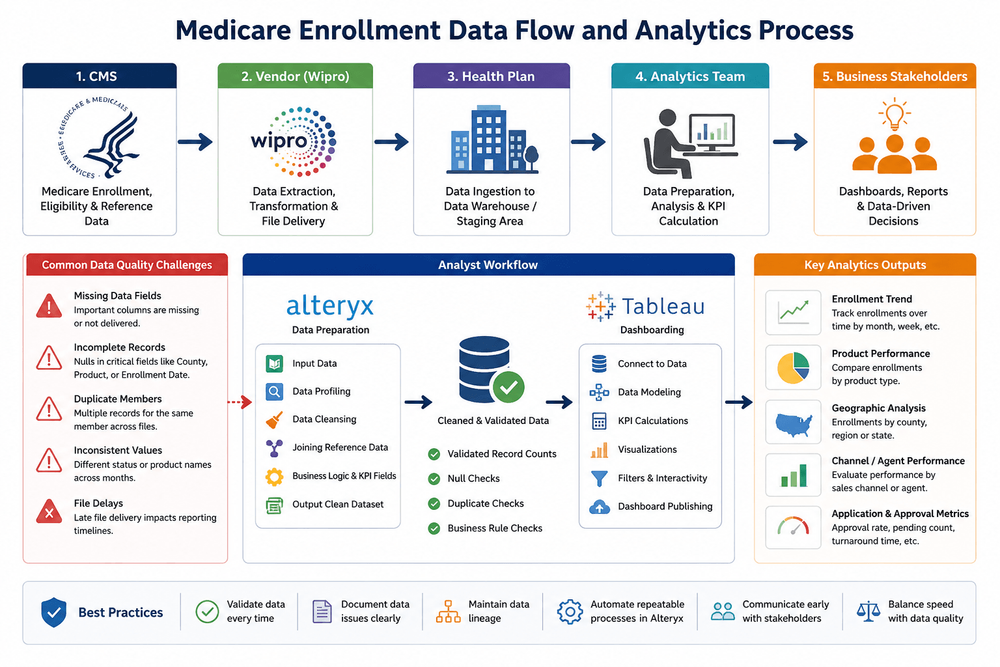
In many healthcare organizations, data travels through a complex pipeline before reaching business users.
A typical workflow may look like:
CMS
   ↓
Vendor (Wipro)
   ↓
Health Plan Data Warehouse
   ↓
Analytics Team
   ↓
Business Stakeholders
At every stage, data quality issues can emerge.
This article explores some of the practical challenges healthcare analysts encounter when working with Medicare enrollment and membership data and discusses techniques for delivering reliable analytics under tight deadlines.
The Reality of Healthcare Data Pipelines
Unlike many technology companies that control their own data sources, healthcare organizations frequently depend on external entities.
For Medicare Advantage plans, enrollment and eligibility information may originate from the Centers for Medicare & Medicaid Services (CMS) and pass through multiple vendors before reaching internal systems.
By the time analysts receive the data, several issues may already exist:
Missing fields
Delayed records
Duplicate members
Inconsistent status values
Unexpected file structure changes
A dashboard request that appears simple from a business perspective can become significantly more complex once data quality issues are discovered.
Missing Fields Are More Common Than Most People Realize
One of the most frequent challenges is receiving files with missing columns or incomplete values.
For example, a monthly enrollment file may contain:
Member ID
County
Product
Enrollment Date
But suddenly exclude:
Broker ID
Subsidy Level
Sales Channel
If leadership expects reporting by broker, subsidy category, or enrollment source, the dashboard cannot be completed as originally designed.
Healthcare analysts often spend more time investigating missing fields than building visualizations.
Questions quickly emerge:
Was the field removed intentionally?
Did the vendor change the extract logic?
Is the field delayed?
Can it be obtained from another source?
These investigations frequently become the critical path of the project.
The Challenge of Time
Healthcare analytics teams rarely operate with unlimited timelines.
Leadership may request:
Daily enrollment reports
Monthly performance reviews
Regulatory reporting
Open enrollment tracking
Often, stakeholders expect answers within hours rather than days.
The challenge is that analysts must balance two competing priorities:
Speed
Business leaders need timely information.
Accuracy
Healthcare decisions require reliable data.
Delivering a dashboard quickly using incomplete data may create misleading conclusions.
Waiting for perfect data may cause stakeholders to miss important opportunities.
Analysts frequently navigate this trade-off.
Building Validation Checks
One of the most effective strategies is implementing automated validation checks before publishing results.
Examples include:
Record Count Validation
Compare current file volume against historical averages.
SELECT COUNT(*)
FROM enrollment_file;
Large deviations may indicate missing records.
Null Value Monitoring
SELECT
COUNT(*)
FROM enrollment_file
WHERE county IS NULL;
Unexpected increases in null values often reveal upstream issues.
Status Distribution Analysis
Monitoring the distribution of enrollment statuses can identify extraction problems.
For example:
| Status | Expected |
|---|---|
| Active | 85% |
| Pending | 10% |
| Cancelled | 5% |
A sudden shift may indicate data quality concerns.
Communicating Data Limitations
One of the most overlooked responsibilities of healthcare analysts is communication.
Analysts are not simply report builders.
They are translators between technical systems and business stakeholders.
When data limitations exist, it is important to communicate:
What data is available
What data is missing
Potential impact on results
Recommended next steps
A simple note can prevent significant misunderstandings.
Example:
Enrollment counts are complete as of June 15. Sales channel information is currently unavailable due to an upstream vendor extraction issue and will be incorporated once received.
This level of transparency builds trust.
Why Data Engineering Matters More Than Dashboard Design
Many discussions about analytics focus on visualization tools.
However, the most valuable healthcare dashboards often depend on work that users never see:
Data validation
Data cleansing
Business rule standardization
Vendor coordination
Quality assurance
A visually impressive dashboard built on unreliable data provides little value.
A simple dashboard built on trusted data can support critical business decisions.
Conclusion
Healthcare analytics is often portrayed as a field driven by dashboards, artificial intelligence, and advanced technology.
While those tools are important, much of the real work occurs long before a dashboard is published.
Healthcare analysts routinely work with incomplete datasets, vendor-delivered files, changing business rules, and aggressive timelines.
Success depends not only on technical skills but also on data validation, communication, and the ability to make informed decisions when perfect data is unavailable.
In healthcare analytics, the hardest part is rarely building the dashboard.
It is ensuring that the numbers behind the dashboard are accurate enough to trust.