
Think of this little experiment: you can only send five emails per year. Which ones will you send? Which wouldn't pass the test? And more importantly, what would you change, and why?
This small test brings certain practices into the spotlight while questioning others you might be taking for granted.
And since such an experiment would massively hurt your bottom line, below, you'll find email marketing do's and don'ts to make every email count.
Let's start with the do's.
Email Marketing Do's: What Brings Results
These are the most important tactics to keep in mind to design email campaigns that resonate with recipients:
Segment your audience
Sending the same emails to all subscribers is like assuming they're looking for the same thing. But they're unique in so many ways. They come from different backgrounds and have different needs, interests, and engagement patterns.
Audience segmentation allows you to send offers, promotions, and tips that speak to recipient needs, which, in turn, secures customer loyalty.
Here are some of the most common segmentation criteria to create targeted groups:
- Location: Where we live shapes which messages we find relevant. Things like climate, habits, and traditions affect our buying preferences and decisions. For example, a winter clothing collection lands differently in Chicago than in Miami.
- Age: Every generation interacts with brands differently. From the type of content they engage with to their favorite marketing channels, these patterns influence the tone, offers, and timing used.
- Behavior: What subscribers do tells you a lot about what they like. Their link clicks, scroll-stopping content preferences, and email open rates all provide a clearer picture of their interests.
- Psychographic data: These insights go deeper, grouping your contacts based on their values, personality traits, and lifestyle choices. Without them, a food brand could target vegans with meat-lover deals.
After segmenting your contacts, personalization is made easy. Just make sure you go beyond adding the subscriber's name. Everything, from the preview text to the time you send the email, should be tailored to your subscriber's preferences and behavior for optimal results.
Use AI as an assistant, not a substitute
Having to write every email from scratch gets challenging, especially when you're juggling deadlines and multiple tasks.
AI tools help overwhelmed marketers beat writer's block and free up time to focus on optimizing their email strategy. You can use AI assistants to brainstorm fresh ideas for your campaigns or ask for improvements in clarity, grammar, or flow. Or you can experiment with tones and improve readability.
Does this mean you should let ChatGPT write your emails? Or invest in yet another expensive tool? Not at all since many affordable email marketing platforms now come with built-in AI writers, even in their lower-tier plans. This means you can generate, edit, and optimize email copy and subject lines without straining your budget or constantly switching between tools.
However, you should always treat AI writers as a helpful assistant, not a substitute for your creativity. They'll give you a boost when you're struggling to find a new angle, explore relevant resources, or polish the final draft.
What they can't do is write the entire message for you. Practically, they can, but the input will be generic emails that lack authenticity and make you sound like everyone else. To avoid that, keep your original voice, brand style, and the human-to-human connection going.
Offer value in every email
Most consumers tune out of brands that demand attention without giving value in return.
This is why you should center your messages around them, providing solutions to their pain points. Sharing educational content with your audience builds authority. With time, subscribers will think of you as a trusted resource and turn to you when they need help or guidance.
Here are some ideas on how value may look in your email campaigns:
- Sharing educational content tailored to the subscriber's stage in the funnel, such as onboarding material to newcomers and thought leadership content to loyalty program members.
- Entertaining readers with interactive elements that may also reveal their preferences, such as a quiz that tests their knowledge on niche topics. That way, you create a memorable experience for them while accessing valuable insights about their preferences.
- Offering free plug-and-play resources, such as templates or checklists to simplify certain tasks for recipients. This is an effective way to promote certain features or products by highlighting use cases and encouraging readers to test the waters.
- Including reports and statistics to showcase results and demonstrate authority in a tangible way. Real numbers make your messages feel less like promotions while giving subscribers something concrete to remember.
Value isn't only meant for educational campaigns. Even when you send promotions and offers, you can provide that by focusing on how the product or service benefits your audience.
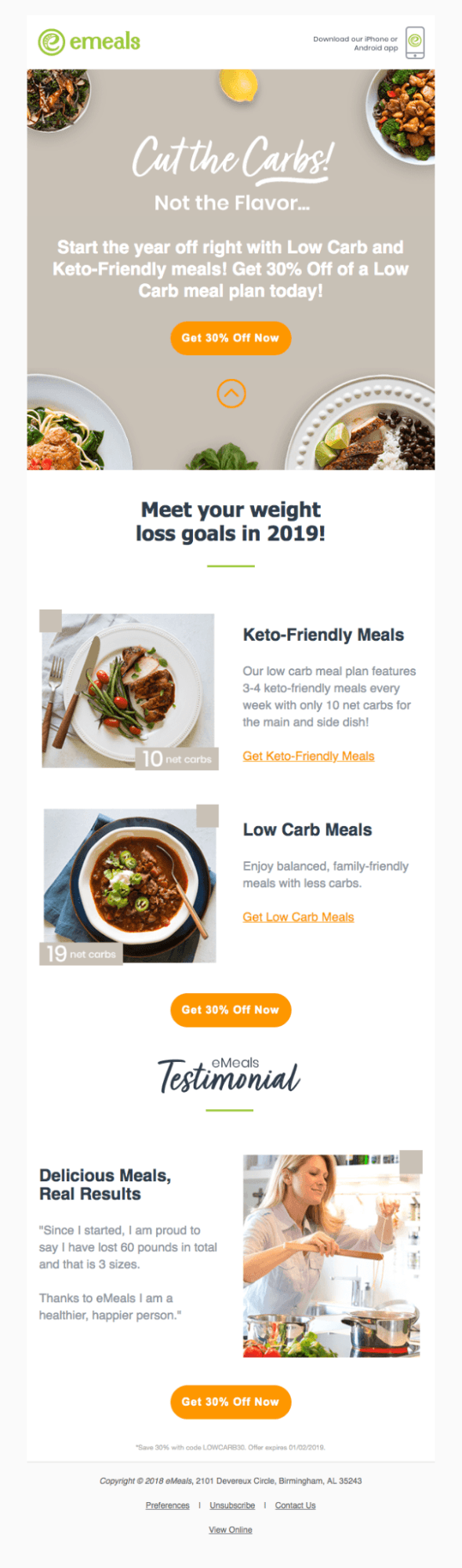
This is how eMeals invites inactive subscribers back with personalized meal recommendations based on their past behavior, plus a generous discount to sweeten the deal.
Subject line: Tasty, Keto-Friendly and Low Carb Meals!
Keep readability in mind
How long has it been since you last read an entire email? Your subscribers are no different. This is why they prefer to grasp the key points instantly. So, before creating a new campaign, you should ensure all readers understand why you're getting in touch and what's in it for them.
The simplest way to do that is by designing an easy-to-read email. Here's how:
- Simplify your email copy by writing in short and concise sentences. Avoid passive voice, corporate jargon, and overly professional language to make your text more digestible.
- Use an organized structure to create scannable emails. Add white space, visuals, and distinct colors or fonts to guide the subscriber's eye.
- Prioritize key information by placing it at the top of the email and highlighting it with bold text or color contrast. To keep things focused, don't introduce multiple objectives at once and offer extra resources in case someone wants to learn more at their own pace.
- Make sure every element serves your email purpose. Don't add videos or GIFs just because they're fun or engaging. Instead, use them to support the value of your message or showcase results.
Experiment but stay on brand
Perhaps you've established that your audience responds well to specific content types and formats. That's no reason to never try new strategies. After all, what works now might not work tomorrow.
Testing new ways to target subscribers allows you to analyze and adjust your strategy. You can use A/B testing to create and send two email versions to different audience groups. The first could include a time-sensitive promotion with urgency elements, while the second could put customer reviews at prominent places.
Or you could leverage specific occasions to try something new. For instance, you can test a birthday email with a mystery reward revealed once subscribers click the CTA. Or deliver an April Fool's campaign with a funny prank but a very real special offer.
However, it's important that you don't deviate from your brand identity. Consumers may love brands that go out of their way to grab their attention, but they appreciate consistency more. So, start safe with low-risk tactics like incorporating a few emojis or puns in your copy. If you decide to scale, choose tactics that fit your business profile.
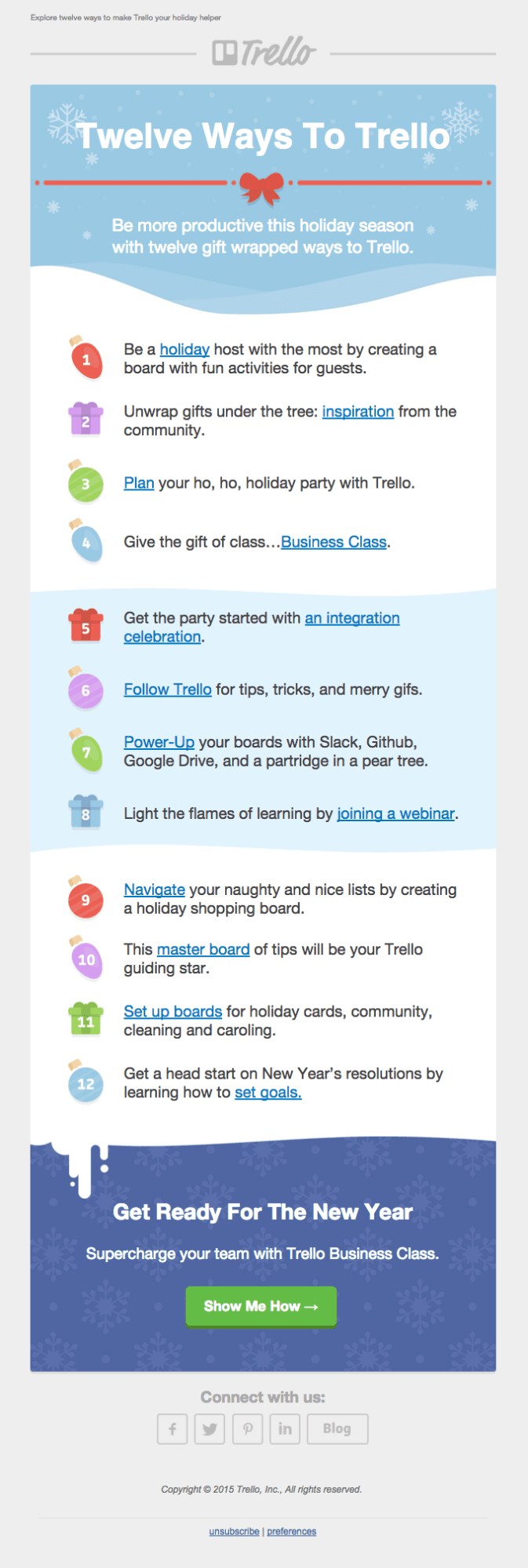
Here's how Trello manages to drive engagement with a list of platform tasks presented as a twelve-day festive list. They do it while staying on brand, aligning the tips with their value proposition, which is to keep productivity high throughout the year.
Subject line: 12 Presents To Make You More Productive These Holidays
Email Marketing Don'ts: What Causes Disengagement
Now let's see the most common mistakes to avoid so you don't risk annoying or frustrating your subscribers:
Don't neglect email frequency
For most marketers, the right email frequency is a moving target since it depends on their current business objectives and audience changing preferences.
In any scenario, you shouldn't leave long gaps between emails because recipients could forget about your last communication, or your brand overall. On the flip side, bombarding them with excessive campaigns in a short period of time could result in email fatigue, spam complaints, and unsubscribes.
The only golden rule is to identify a cadence that works both for you and your audience and keep it consistent. Also, use your signup form or welcome email to set expectations, informing subscribers on how often you'll deliver emails.
Another best practice is to email subscribers only when you have something meaningful to say, whether that's business updates, special deals, or reminders. Lastly, use a preference center to give recipients control over the optimal email frequency.
Don't deceive your audience
Misleading your customers with tricks and deceptive tactics is like opening the door for them to walk away. Think of each time you opened an email due to a clickbait subject line. How did it make you feel?
You might believe that such a subject line will increase your open rates. And it will. However, when it promises one thing and the email content doesn't deliver, subscribers can instantly tell that the brand doesn't respect their time.
The same goes for overdoing it with urgency and scarcity. Consumers are aware of the FOMO effect, and if every email you send screams "LAST CHANCE", they'll quickly spot it. So, save these tactics for when they make sense, such as flash sales or limited-edition deals.
The most effective way to get recipients to open and read through your content is to be upfront about what they should expect and meet these expectations without maneuvers.
Just like Casper does in the following email. They announce a subscriber-only offer and subscribers can easily claim it using a promo code shared in the email, no strings attached.
Subject line: Subscriber Exclusive: 25% off Mattresses (our best July 4th offer)!

Don't make unsubscribing complicated
Just because someone chooses to opt out of your emails, it doesn't mean you should end on bad terms.
Honoring an unsubscribe request is both an act of respect and a legal requirement. It also helps you maintain a positive brand reputation and a healthier email list. Remember, an unsubscribe might improve engagement down the line. Plus, it's always better than a spam complaint since email providers don't penalize senders for letting people opt out.
So, all your emails should include a clear and prominent unsubscribe option. Avoid turning unsubscribing into a multi-step process and immediately remove contacts from your list once they submit their request.
If you want to hear their feedback, you can use a short poll on your unsubscribe page to ask why they opted out. But keep it simple and optional so they don't feel like they exchange their insights with the right to leave.
Don't purchase or sell email lists
While it seems like stating the obvious, this advice never goes out of style. We'll start with the fact that purchasing or selling email lists is illegal due to regulations like the European General Data Protection Regulation (GDPR) and Canada's Anti-Spam Legislation (CASL). It's not worth the penalties and fines just to have more people on your list.
The law isn't the only entity you'll have trouble with. Email clients and their filters can flag your campaigns as spam if you don't use crystal clear methods to acquire leads or if you don't manage their data properly.
More importantly, this tactic may get you more subscribers quickly, but not engagement or conversions. These purchased contacts probably didn't consent to their data being sold to other companies. As a result, they won't care about your selling proposition and won't think twice about marking your emails as spam.
All these have an impact on your email deliverability and sender reputation. So, when trying to generate leads for your business, the only correct method is to do it organically.
It takes more time and effort, but the people joining your list this way will want to receive your emails and offers. Always use double opt-in so every new subscriber takes that extra step that ensures fake or mistyped addresses don't get in.
Put Intention at the Center of Your Email Strategy
Following email do's and don'ts to send the right email campaigns isn't a short-term goal. Email best practices change, as does how consumers feel about brand interactions.
Before sending the next email, ask yourself whether it undermines customer trust and loyalty in any way. If it does, don't send it. Instead, deliver messages with intention, quietly training subscribers to expect value in every email.
The key to successful email marketing is to keep moving. Be on the lookout for new strategies, test, and monitor results to identify what sticks with subscribers. And don't forget to ask for their feedback. That is and always will be your most reliable source, guiding your way to better emails.
FAQs
Here are some answers to frequently asked questions about email marketing do's and don'ts:
1. Why should businesses keep up with email marketing best practices?
Staying up to date with email best practices maximizes your chances of reaching and engaging your audience. A carefully crafted campaign that respects compliance and provides value builds trust with both subscribers and email providers. Over time, this reinforces your authority, strengthens sender reputation and sends your emails to inboxes instead of spam folders.
2. How can you tell if your email efforts are working?
Start with A/B testing to check how different subject lines, formats, and CTAs land with subscriber groups. Also, track key email metrics like clicks and conversions to measure performance. For example, if your conversion rate drops, experiment with CTA copy or placement. You can always use your own emails to gather direct feedback, asking recipients what they enjoy and what you could improve.
3. How do you ensure your emails don't come across as salesy?
It's easy to go overboard with promotional language when there's pressure to drive sales. But if every email asks for something, it feels pushy. Balance is everything. A good ratio is 3:1 educational to promotional content. But even when you send offers, frame them as personalized solutions to the recipient's pain points rather than a sales broadcast.