
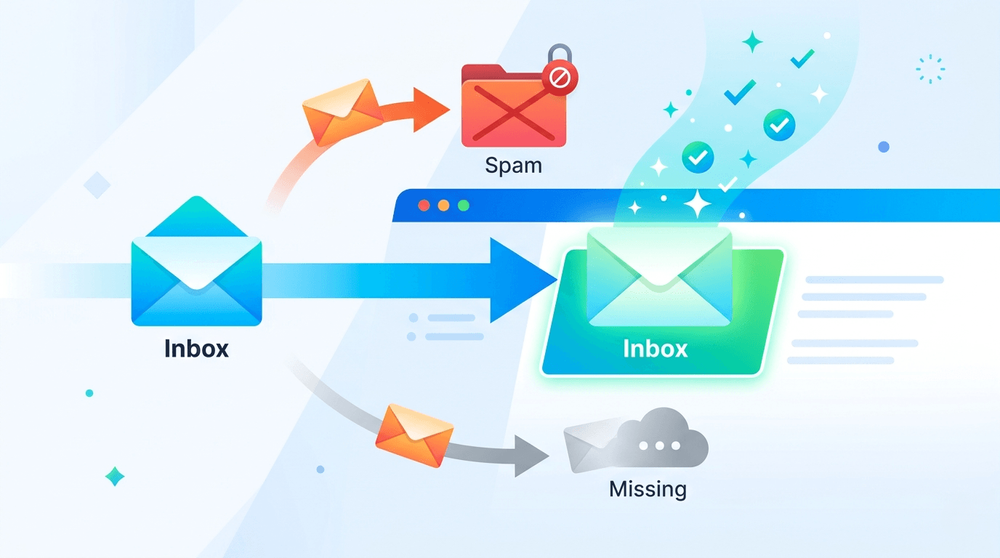
You can write a brilliant subject line, build a gorgeous email, segment the right audience, and line up the perfect offer. However, none of that helps if the message lands in spam, disappears into "Promotions" purgatory, or never reaches the inbox in the first place.
That's why email deliverability matters so much. In simple terms, deliverability is whether your email is accepted, filtered, and ultimately placed in the inbox rather than the spam or junk folder.
That placement decision is made by mailbox providers like Gmail and Outlook based on a combination of authentication, sender reputation, and user engagement signals.
Validity's 2025 Email Deliverability Benchmark Report found that global inbox placement averaged 83.5%, with 6.7% of legitimate marketing emails going to spam and 9.8% going missing altogether. So, about one in six legitimate emails failed to reach the inbox.
Key Takeaways
- Email deliverability is about inbox placement, not just whether an email was technically delivered.
- Poor deliverability suppresses visibility, which in turn lowers opens, clicks, and conversions, regardless of how strong the email itself is.
- Mailbox providers increasingly tie inbox placement to authentication, complaint rates, and sender reputation. Google now requires bulk senders to use SPF, DKIM, and DMARC, and to keep reported spam rates below 0.3%.
- Deliverability compounds over time. Mailbox providers use historical behavior to determine future placement, meaning past performance directly influences future inbox access.
Why Email Deliverability Matters
Deliverability is often treated like a backend detail for the person who knows what a DNS record is and has seen too much of it. That view is too narrow, as deliverability affects visibility, engagement, automation performance, revenue, and brand trust.
In other words, email deliverability is a prerequisite for the performance of your email newsletters.
1. Your emails need to reach the inbox to work
Let's make an important distinction first:
- Email delivery means the receiving server accepted your message. It says nothing about where the email ends up (the primary inbox, spam, or the filtered tabs).
- Email deliverability refers to inbox placement, so it describes whether your message reaches a visible, high-attention environment rather than being filtered or suppressed.
This is the part some marketers gloss over because "delivered" feels like a success metric. It isn't. An email can be accepted by a mailbox provider and still end up in spam, junk, or a rarely checked tab. From a technical standpoint, it was delivered. From a marketing perspective, it may as well not exist, as its chances of being opened or clicked drop significantly.
That placement isn't random. Mailbox providers evaluate each send based on past behavior, authentication, complaint rates, and engagement.
If those signals suggest risk, the message is more likely to be filtered, deferred, or routed elsewhere. Less visibility means fewer opens, clicks, and conversions.
2. Deliverability shapes your engagement metrics
Once visibility becomes inconsistent, everything downstream starts to distort. Open rates drop, click rates soften, and conversions underperform. In that case, the first instinct is to fix the email by rewriting the subject line, adjusting the CTA, or rethinking the offer. And while those tweaks usually work, they don't address the root cause when the issue is inbox placement.
This is especially misleading for teams investing in affordable email marketing solutions that expect strong returns from a cost-effective channel. On paper, it all makes sense: low cost, scalable reach, measurable performance. But if your emails aren't consistently reaching the inbox, those returns don't fully materialize.
When a portion of your emails gets filtered out, your metrics stop reflecting performance and start showing exposure instead. So, you're no longer measuring how effective your message is, but how often it had the chance to be seen.
That's where deliverability becomes expensive, leading to incorrect decisions that push you to optimize variables that were never the root cause, while the real issue remains unresolved.
3. It protects your sender reputation, which affects future campaigns
Deliverability isn't judged on a campaign-by-campaign basis. On the contrary, it's based on your overall sending history. Sender reputation is cumulative and continuously recalculated.
Google's Postmaster Tools surfaces metrics such as spam rate, domain and IP reputation, authentication, and delivery errors because these signals help determine how mail is treated.
These signals don't contribute equally to sender evaluation. Spam complaints and user disengagement have a significantly greater impact than positive signals like opens, meaning negative behavior degrades reputation faster than positive behavior builds it.
That's why deliverability issues often extend beyond a single campaign. A neglected list, rising complaints, or inconsistent sending patterns can erode trust with mailbox providers. And once that trust drops, future campaigns are more likely to be filtered before they even have a chance to perform.
In practice, this creates a feedback loop:
- Lower reputation leads to worse placement,
- Worse placement leads to lower engagement,
- Lower engagement reinforces the idea that your emails aren't wanted.
As a result, mailbox providers respond accordingly.
That's why most deliverability guidelines focus so heavily on engagement and list quality. If you consistently send to people who don't interact, or keep inactive contacts on your list, you're actively weakening your reputation over time.
4. It has a direct impact on revenue and ROI
Deliverability is often filed under "email ops," while revenue conversations happen elsewhere, with more slides and worse coffee.
But the link is straightforward. When fewer emails reach the inbox, fewer people see the offer, which leads to fewer clicks and, ultimately, fewer conversions. That's the basic math of a channel built on attention.
That makes deliverability one of the levers that can improve performance without rewriting a single headline. Sometimes the most efficient way to improve campaign results is to fix the conditions that decide whether the copy gets seen at all.
Especially in lifecycle email marketing, where revenue often depends on data prospecting that results in timely messages, poor deliverability systematically undermines the effectiveness of high-intent flows.
5. It affects trust before the reader even opens the email
Inbox placement can also affect how you think and make decisions. When a brand consistently lands in spam or junk, it loses credibility. The mailbox provider has effectively signaled, "We are not fully convinced about this one," and that isn't exactly the warm introduction marketers are hoping for.
Trust is especially fragile in high-intent or high-friction moments like onboarding, webinar reminders, or reactivation campaigns. If those messages are delayed, filtered, or buried, the user experience takes a hit, and the brand often gets blamed for being unreliable, even when the underlying issue is sender reputation or infrastructure.
After all, the recipient doesn't care that the DKIM was having a hard week, this is for you to understand and solve. What they do care about is your email's inability to reach them.
6. It determines whether your automations work or fail
Automation tends to look impressive in a strategy deck because the boxes connect nicely and the arrows imply control. In reality, an automation workflow is only as effective as its deliverability.
This is particularly critical for trigger-based emails, where delays or filtering directly break the intended user journey. A welcome sequence that hits spam is a beautifully engineered missed opportunity. An abandoned cart flow that lands in junk simply doesn't show up for work.
This is where deliverability becomes silently dangerous. Automation failures can hide in averages, especially when workflow volume is low or teams focus only on send counts rather than placement quality. That makes inbox placement essential, since timing and relevance are the whole point.
7. It gives you cleaner data and better decision-making
Poor deliverability distorts how you interpret performance, and that's where the real damage happens.
When inbox placement is inconsistent, engagement metrics stop being reliable indicators of message quality. In cold email, for instance, where reply rates are the main success metric, low responses can easily be misattributed to poor targeting or messaging, when the real issue is simply a lack of visibility.
Also, a drop in opens or clicks doesn't necessarily mean the subject line underperformed or the offer missed the mark. It can just as easily mean part of your audience never encountered the email in the first place.
This creates a structural blind spot. A/B tests, benchmarks, and historical comparisons all assume consistent exposure. When that assumption breaks, so does the validity of your conclusions.
As a result, teams iterate on creative, test new angles, or shift strategy entirely, trying to fix what appears to be a performance issue while the real problem remains untouched. Over time, this leads to wasted effort and inconsistent outcomes, with campaigns feeling unpredictable because visibility isn't controlled.
That's why deliverability needs to come first. Before optimizing performance, you need stable exposure. Otherwise, you're just reacting to noise.
So, Why Is Email Deliverability Important?
Because it decides whether email marketing gets the chance to work.
It affects visibility, which in turn dictates engagement and revenue. It shapes sender reputation, influences future inbox placement, impacts automation performance, and increasingly determines whether senders meet the requirements that Gmail and Yahoo now expect from legitimate programs.
Treating deliverability as a backend concern is one of the easiest ways to sabotage a good email strategy without realizing it.
Deliverability might not be as glamorous as email design, and nobody throws a party for SPF alignment. But inbox placement is the condition that makes every other email win possible.
Frequently Asked Questions about Email Deliverability
What is email deliverability in simple terms?
Email deliverability is the ability to get your emails into subscribers' inboxes rather than the spam, junk, or promotions and updates tabs. It differs from simple delivery, which only indicates that the message was accepted by the receiving system.
What affects email deliverability the most?
The major factors include sender reputation, authentication (SPF, DKIM, DMARC), spam complaint rates, bounce rates, list quality, and recipient engagement signals such as opens, clicks, and deletions without interaction.
Why do emails go to spam?
Common causes include weak authentication, high complaint rates, poor list hygiene, sending to disengaged contacts, and reputation issues.
Does email deliverability affect open rates?
Yes. If emails don't land in the inbox, fewer recipients will see them, which naturally lowers opens and clicks. That is why placement has to be considered before creative performance is judged too harshly.
Is deliverability a one-time setup?
No. Authentication is part of it, but deliverability is ongoing because sender reputation is shaped over time by complaints, engagement, bounce behavior, and sending practices. It is something you maintain, not something you "finish" after a technical setup sprint.